Showing posts with label Permaculture. Show all posts

Friday, June 28, 2013

The Lustful Lettuces of June


Once, when I was a dewy-eyed twenty-three year-old I told my friend Amy that I wanted to live on a homestead with a geodesic dome and several goats.

She snorted at me. It was very rude. (I'm not sure why I was—and am, after almost fifteen years—still friends with her.)*

"What?" I demanded. She said something about fantasizing. I was deeply offended and drew myself up to accommodate the large stick now materializing in my rear end. "How do you know this isn't my life's purpose—my POSSIBILITY?" I asked her.

"Because," she told me calmly, "it doesn't make you happy when you talk about it. It makes you flustered—and annoyed that you don't have goats."

That seemed to put the conversation to rest.

I still don't have any goats and, given the state of my back yard after years with only a dog in it, I think goats may be out of the question. That said, I have gone on to have ducks and then chickens and to  put in one garden after another at my house (completely without geodesic domes).

So, perhaps we were both right, in a way.


It is nearly July now, and it is hot. It has been in the nineties the last few days. I planted quite a lot of lettuces this March and we have been eating them since May. Every time I harvest a small head here or several leaves there, another lettuce merely stretches out and yawns, relieved to have been given the extra space. I can't get rid of them. They appear to be multiplying. Every night the menu is something and salad. We have to eat this lettuce, I tell everyone. I can't stand waste.

"Yum," I say.


So, now the lettuce is thinking to itself, "Ahhh, it's hot." It is starting to feel sort of sweaty and sexy and wanting to reproduce. The lettuces now go shooting up seed stalks with pretty little flower crowns atop their heads. Some of them can do this, fine, and I will harvest the resulting seed. But a whole half-bed of lettuces in flower, too bitter to eat, I do not need. So, we are gifting lettuces not yet bolted to our friends.

"Here, have a lettuce! Take two! Have a ladybug with that!"


We are pulling things up willy-nilly and calling this Bacchanalian scene of lettuce lust a wrap. And thinning carrots. Because, for some reason, I haven't done this yet. I am pulling up itsy-bitsy, teeny-weeny onions crowding in on the great big beauties and preparing, perhaps, to make onion frittatas for little elves. My littlest son is with me, goggling over purple carrots, sticking his little brown fingers deep into the soil to feel around the tops of tap roots and pulling others out. He is holding lettuces like bridal bouquets and feeding some of the sun-starved leaves to chickens, who are begging for scraps like a horde of gypsy children rushing tourists in a square. We are nibbling sugar snap peas as we work. And, of course, he is shirtless and wearing his pirate costume pants inside out. Which is exactly as it should be.


So, things are perfect. Although, I think you will agree that the situation could be improved by a few goats.


*unless it's because she's been the sort of friend that coached me through two births, one divorce (not in that order) and makes an hour to talk to me anytime I need to talk to someone who will "get it" and know that she is the only one.

Tuesday, May 28, 2013

Homes for Tomatoes

The arugula has already bolted.

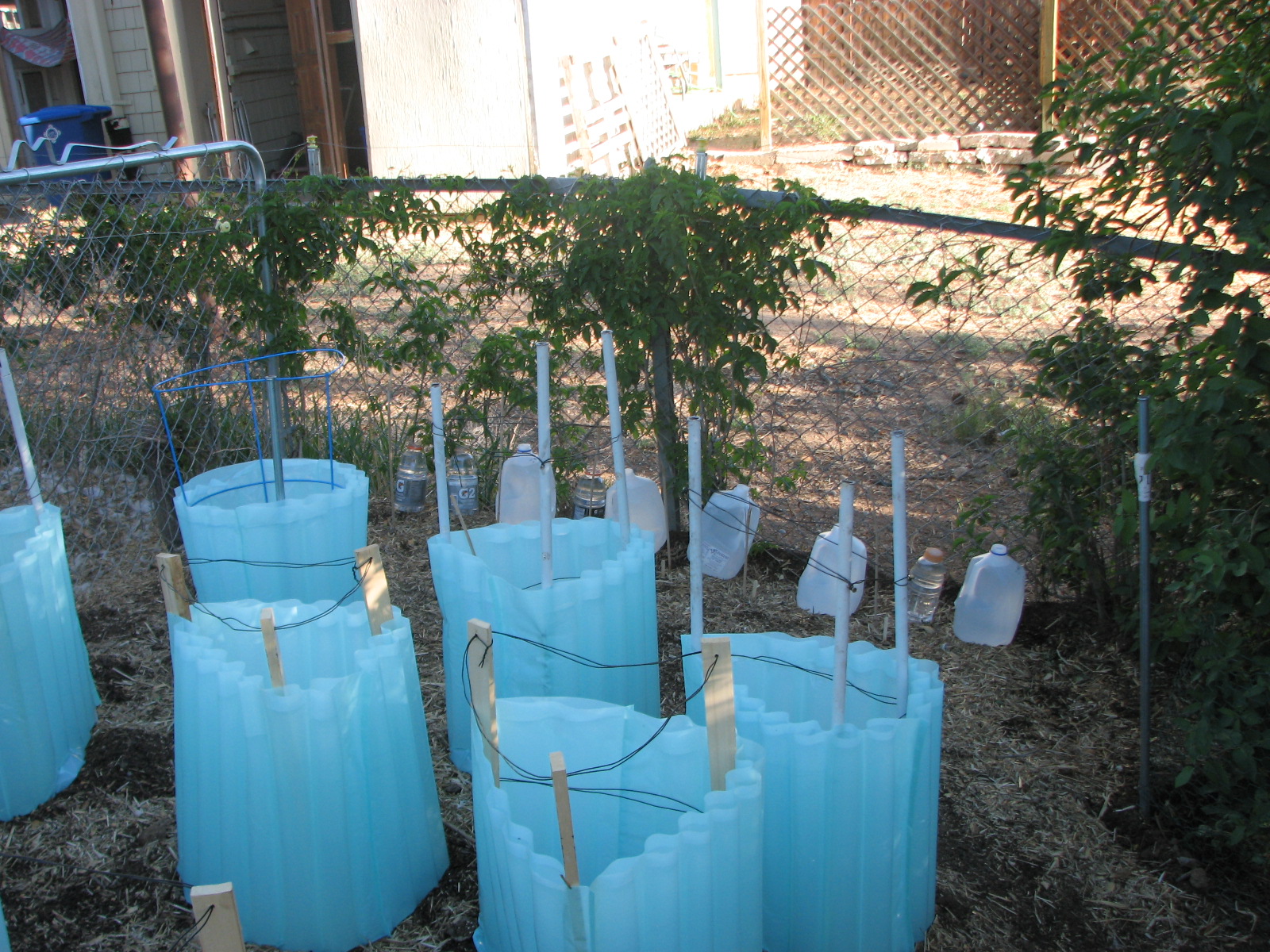
We spent the weekend making homes for tomatoes. Digging nice, deep holes, spaced a bit too close, and slamming in stakes in the ground for makeshift cages. Running baling wire 'round the cages for horizontal support. Buying clear plastic to frame them in for added heat; then realizing we really needed Walls of Water instead. Sowing bee balm, calendula, Thai basil, oregano, and nasturtium in the plot so that, when finished, this one piece of earth is a verdant eruption of vining Scarlet runner beans and Lemon Queen sunflowers, hot peppers and green and black and red tomatoes; an Eden awake with blooming and buzzing and the pungent taste of herbs.

Makeshift tomato cages in progress in the new garden area.

From this fenced plot I can see my chickens sorting through the straw, scratching every square centimeter of yard in their patient search for bugs. Running with pieces of thrown dandelion, pursued by other chickens, because nobody wants to share. Blissfully napping under the big lilac, in abnegation of the sun. I have never seen them from this view before; they look cuter than usual.

Sasquatch the Brahma

To my left, in another bed, I have lettuces in untidy rows like the bustling organdy of a recital of small green tutus. Varieties run from spiky to solid, smooth to soft, and my favorite Black-seeded Simpson is dressed in wavering lines. Next to them, onions and leeks have become tall princesses, wearing tiaras of static-shocked electric white, their feet emerging in white and red bulbs in the rich dark soil of the covered bed. Among the edibles, a single columbine has bloomed and hangs a flower like a lantern for fairies lost among the peas. White pea flowers sit next to forming baby pods, sugary and innocent. Undiscovered asparagus spears have shot up to tickle the atmosphere, spreading in ferns and hanging berries, which drop into the mud. Carrots do their work deep beneath the soil, sending only their punk hairdos up.

Carrots, onions, lettuces in the cold crop bed.

In another bed, Egyptian onions have set blossoms next to chives like firecrackers—green sprays tipped with purple asterisks. Cucumbers volunteer from last year and poke their leaves out of the straw mulch. Jerusalem artichoke is everywhere, but still earthbound, nothing more than leaves spreading just above the soil. I have to use my imagination to remember what it is.

This is a Welsh bunching onion next to some Jerusalem artichokes in my perennial edible bed.

All of these plants live here. In a way, it doesn't look like much. Just a bunch of beginnings. Very little now that you can eat. And yet, there is nowhere I am happier than here, with my husband beside me, armed like Thor with his sledgehammer, putting the stakes just where I say. The two of us, in the shadow of my crabapple and my honeysuckle, making beginnings, putting work to hope, with faith that things will grow.

Ready to be planted! Northern NM nights are cold. The full bottles behind the peppers are for thermal mass.

Tuesday, September 4, 2012

A Prayer with Arugula


The arugula was the only thing I had sown this year from my own seed: a child of last year's arugula. I had allowed the plant, past its prime, to bolt and grow tall, to go to seed—ugly and rangy in my garden bed–—and pulled each dried-up pod, carefully harvesting little plant embryos from the chaff. Putting these in an envelope sealed with faith in biology and hope, I stored them overwinter and brought them out again last spring, sprinkling them chaotically in my salad bed to start again.

Up they came, and produced their delicious shoots of rocket to be cut into salads, added to sandwiches and tossed to passing ducks, who eschewed them for their bite. In July, they bolted in the heat again and I let them do their business, making more baby arugula for years to come. It was hot and heavy in the vegetable bed; bees abuzz and flowers of other lettuces coming into bloom as I lazily let anything past its prime pass into seed. Again, I harvested the seed and put it up in envelopes for a spring to come.

Yesterday, as I went about my business in the garden, peeking under winter covers to observe the infant growth of beets, onions, greens, broccoli and carrots, I saw something in the path. Arugula had scattered its seed on the garden path and sent up shoots, now a third generation grown on my land. Like so many careless sexual creatures, this angiosperm had spent its seed outside the confines of its home. There is such a delightful imperfection to this business of sexual reproduction—the mixing of genes, the crazy tangle of DNA. It would be less messy were we all but cuttings of one larger plant—the image of God, perhaps—but how much less interesting the world!

Over time, my arugula, having grown generations on the discrete micro-climate of my yard—will select for a variety perfectly adapted to the wind, the shade and sun here; perhaps even the watering habits of its grower. Each year, I will set seed, and the best arugula will grow. The arugula that survives will live to put forth flowers and turn flowers into seeds. I will harvest those seeds and start again; each year a new generation of peppery oval leaves—great-granddaughters of those I grew before. It is hard not to feel I am presiding over something rather great.

All the religion I need, for the most part, is spoken of in that arugula. Praise Glory, Praise Glory. Hallelujah to the world. I am fully in love with and devoted to Creation. Listen, listen. The decomposers work the soil at its little green feet. The beans spin sugar out of air and make a gift of it to the soil. The calendula keep nematodes at bay. Pollinators buzz and light. Predator robins swipe a caterpillar off a branch. Nature keeps putting forth. She is spilling her gifts upon my family—larger as I learn how to work with Her ways. I sit in the sunlight laughing.

Praise Glory. Praise Glory. Praise Glory.


Wednesday, April 11, 2012

Wisdom From the Soil: Process Matters


Now that I am gardening again, it seems to me that all of the collected wisdom of human existence can be rediscovered in this process of producing one's own food. Every time I reach for the metaphor I want to  express an abstract that I am writing, my hand grasps something covered in soil.  The world tends to filter through me like that–in great gushes of meaning–pounding onto me like monsoon rain, until I am drenched beyond reason, standing in pools of analogy. At some point later, I will look back and think indulgently, "Ah, gardening, was it? How quaint."

Gardening, though, it is. I am sorry if gardening is not your thing. My writing, when I am not attempting to make fun, is the sermon given by a dilettante obsessed with the poetry of ordinary living. Or a preaching of the doctrine of "provoking a bee hive to see what the bees might do." Life is this Bible which is constantly illumining me with its intricate strangeness, causing me to sing Hallelujah. All I want from my readers is to go to church with me.

Today I am interested in process, in means and ends and the ripples that they cause in groups of humans when decisions, like a stone, are thrown in among them. This is where permaculture and other organic gardening practices depart from conventional and it is where communities of intention depart from communities of expediency.

There is a tree in my front yard, a large elm, that has grown too large. I am in favor of elms. They are all to the good, providing natural habitat for faeries, children and compost piles as they do.  This one, though, has grown old and arrogant. It is reaching its crown to brush our power lines, its long, rooty toes deep into our sewer system and is overshadowing a lilac bush, which now fails, almost every year, to bloom. It occurred to my husband that it could be removed and that we could then plant a few fruit trees in the area, which would grow shorter and, of course, produce food. I like this idea, in a practical sense. In an emotional sense, I never feel quite comfortable with the cutting of a tree on my property. It's always as if someone has suggested casually that we slaughter an old elephant. Trees have character. Perhaps I am an animist. I do not feel that one should just cut down trees willy-nilly. I do concede, however, that its relationship to our power lines and sewer are problematic.

My husband's friend, who we hire to do general work for us, suggested that we could cut our elm and then inject poison into the stump to kill the roots. I smiled politely at this suggestion, and immediately prepared to go to war against it. I am not an expert on tree removal. If, perhaps, this is the only reasonable way to rid oneself of invasive tree roots, I am sure we will soon know, but I am not prepared to casually introduce blight into a soil I have treated like a soup gently simmered over the years. The relationship between a plant and the soil is reciprocal. The plant pulls water, draws nutrients, and introduces elements back into the soil. This is why we plant nitrogen-fixing plants in gardens to improve the soil. Knowing this demands that one think further than simply getting from A to Z, on a more complex level than tree to soil. It requires thinking like a system.

It is the same with decisions made in a body of people–in a family, in a community group, in a workplace. Process matters. It matters, in many ways, more than results. If you have loaded your soil with chemical fertilizers, pesticides and weed-killer, if you have farmed it in a way to work the land to exhaustion, you may yield a cornucopia for a year, but your soil will die. And if you make decisions outside of established processes, allow power to collect in the hands of too few, and only inform others later of decisions that have been made without them, you will kill your community. To foster an engaged group of employees, volunteers or family members requires that they know they have a role that matters. Systems of democracy, or systems for input, are built up to provide perspective, to spread responsibility and to balance the representation of different points of view. It is never safe to ignore them in order to get things done faster or more easily.

In the nineteen years of my adult life, I have been privileged to be a part of many different communities, all of which functioned very differently. Some have been groups organized around a cause or common purpose, others around a spiritual need. I have been there to see many of them falter and lose their way, and this always happened when they failed to define a process by which decisions could be made democratically or to stick to that process. The most successful, inspiring community I have ever been a part of was the General Service body of Alcoholics Anonymous, its democratic representation. There are more checks built into that system for valuing the opinion of the minority, for gaining the perspective of as many as possible, and for slowing a headlong dash toward any major change than I have witnessed anywhere. It was thrived for almost sixty years and kept an organization alive that saves people's lives every day, despite being run entirely by people who are fundamentally crazy. Not every organization could, or should go as far, but most could go much further in the direction of what AA has done.

Process matters. Healthy soil is more important than a first harvest. A strong community is more important than a good decision. In the end, a rich soil will yield a bounty. In the end, a macerated soil will kill fruit on the vine. When in doubt, always invest in your soil.


Monday, April 9, 2012

A Photo Journal of My Spring Break: a Garden and Egg Obsession


I have already shown you the faux stone duck eggs I dyed for Easter, and your well-feigned enthusiasm toward these has inspired me to show you more of the weird things that I spent my spring break doing, rather than writing for you. (At least after I had recovered from the Ebola.) This will bother my teenager because he says that he doesn't want any of his friends "to know that we are hippies." Hopefully, then, none of them read this blog.

The day after I had dyed all the other eggs using smelly vegetable matter, I was getting ready to make good on my promise to dye some more with the kids. Having not purchased a PAAS dye kit, I realized though, that I lacked one of those wire egg holders for dipping eggs in the dye. This lead me to Google in search of a solution to my egg-holding problem. There, I accidentally discovered that I could do something much, much  cooler. My kids had friends over again, so I went into he living room and said to two teenage boys,

"I have a scheme for dyeing eggs using flowers and pantyhose. You are going to love it!"

The boys looked at one another with an expression of stifled mockery and continued silently eating banana muffins. However the eggs, which I did mostly on my own, with limited interest from my own children and one sweet young girl who was there to play with my youngest, were super-cool.


In addition to dyeing eggs, which one might easily assume took almost my whole spring break in and of itself,  I started several gardens. Here is the short story on those. If you don't care about gardening, you should skip this part. It will bore you to death.


We planted Adirondack blue and Yukon Gold potatoes into straw bales. To do this, you wet down the straw bales thoroughly, and then dig holes straight down to the ground and fill them with compost, into which we planted the seed potatoes. I very much hope they will grow because I cut and dried the potatoes way earlier than I was supposed to, when I saw that they were rotting in the bag and making my kitchen smell like dead cats. I suppose if they don't show growth soon, I will buy some starts, if I can get them, and replace the shriveled seed potatoes with those.


This raspberry bed has been sitting over winter, stewing compost and pine needles, getting ready to be planted.  It is just downhill from a duck pond so that I can take advantage of run-off. These particular berries are summer-bearing Lathams. Our native soil is alkaline, and so I hope the compost and pine will help acidify it enough for the berries.


I planted twelve ever-bearing strawberries in a 4 x 4 space by my front door, which will be much too hot for them this summer unless I do something. There is still danger of frost here until May 19–in fact, it snowed just five days ago–so I am covering these with a frost blanket every night. It's an experiment. Also, just behind this bed you can see our clean-out, so, in the event that our drain is irrevocably clogged, a sickening morass of sewage and Drano will enter this berry bed and render it a toxic waste area. My hope is that this will not happen.


Here is where I planted out snow peas in my east-facing garden bed. I also started lettuce and purple kohlrabi seeds. I still need to get my radishes, calendula, cabbages, carrots, and spinach in the ground, too. Truth be told, I am having a hard time nailing down planting dates. Mother Earth News gives me one set, Farmers Almanac another, my southwest permaculture book another, and locals I talk to are all over the map. At least, growing from seed this year, I am not spending a great deal on plants, so I can experiment and learn what is too early. Not that I won't be homicidally angry about any failures.


I still need to start seeds inside to be planted after all danger of frost has passed: small watermelons, pumpkins, delicata squash, lemon cucumber, strawberry popcorn, purple tomatillo. I already have three varieties of tomato resting on my windowsill, preparing themselves for the moment it will be safe to venture outside enshrouded by walls of water.


The neighbor who lives in the other half of our duplex had donated two raised beds in the front of his house to our cause. With a southwest exposure, they should be perfect for the cucumbers, tomato, tomatillos and herbs. Hours of labor removed hopefully all (or enough) of the root systems of weedy yarrow, clumps of grass, and dandelion with roots driven into the soil like inoperable tumors. We sifted rocks using an old screen door, turned in compost and laid straw on top to discourage neighborhood cats from viewing our beds as "pimped out litter pans." (I have to credit Rowan with that moniker.) This was the point at which my children, who had been forced to labor all day pulling weeds and moving compost, starting saying "permaculture" the way that one normally says "dog turds."

I am dying to tell you about the plans for my three sisters garden bed and more straw bale raised beds for the melons and squash, but I will wait until there is something interesting that I can take a picture of.

On Easter, we had some good friends over for dinner and served the duck we had slaughtered last fall, after finding him injured in our backyard.  He was huge when he was alive–by far the biggest duck in our yard, but by the time we had slow cooked him, stuffed with onions, apple and thyme, he turned out to have been anorexic. There was hardly any meat on him at all, and it was a very good thing that I also had cooked ham. It really makes me wonder about the poultry I buy at the supermarket and what it actually looked like as a living beast, if that giant, oafish duck amounted to only a couple of slivers of brown meat.

I guess this whole thing does make me sound like something of a hippie, but I want you to know that during our Easter dinner, my hyperactive male children were running around with our guests, engaged in pitched Nerf battles on a 16 foot trampoline, the part of my earth mother sensibilities that involve peace, love and wooden toys having been beaten to death many long years before.

I hope that you too had a spring break (if you got a break) filled with the sort of bizarre adventures that make good blogging material. I will try to write an actual post at some point in the near future, since there are no more eggs to dye.

Here is Mikalh hunting for Easter eggs on the pretty side of my front lawn, while his big brothers look on.


Friday, April 6, 2012

Like most artists, my work is not always understood.


Right now it is spring break for me. Day seven of my ten days off of work. (This is one of the major benefits of working in education.) However, I spent the first five days of this break suffering from either the stomach flu or Ebola–I'm still not entirely sure–and so yesterday, when I finally felt only mildly queasy but basically energetic, I did what any normal person would do, who is just clawing her way back from the brink of death, and dyed Easter eggs in eight kinds off natural materials.

I have been collecting duck eggs for this purpose for a couple of weeks and I decided to get going right away. First, quite practically, with the aid of my eleven year-old I prepared a slow-cooker dhal for that night's dinner and cleared that away. Having done that, I gathered my dyeing materials, as follows.

5 bags Red Zinger Tea=Violet
Red Onion Skins=Red
Red Cabbage Leaves=Blue
Spinach Leaves=Green
5 bags Green tea=Yellow
Espresso=Brown
Yellow Onion Skins=Orange
Beets =Pink

To each of these materials, I added 2 cleaned duck eggs, a splash of white vinegar and enough water to cover the eggs. I brought them to a boil, then simmered them for 15 minutes. At this point, I checked colors, discovered that all the eggs were still abysmally pale and decided to leave them sitting in the dyes all day. By the end of the day, I had the following results:
  • The spinach water wasn't even green, and the egg was still white. I got pissed off and added a couple of drops of green food color.

  • The yellow and red onion skins had produced identical results–a deep burnt sienna color.

  • The Red Zinger eggs were not violet but grey.

  • The espresso eggs were brown. I wouldn't recommend eating them, though.

  • The green tea eggs were more olive than yellow. Maybe I left them in too long. 

  • The beet eggs were white. I added red food color, after all the others were done (which is why they missed this photo shoot.)

  • The red cabbage eggs actually came out blue. Hallelujah!
One interesting problem was that, since these were homegrown eggs, cleaned by mere mortals, some of the protective  bloom had remained, and this caused them to dye unevenly and to peel in an odd way. I decided to work with it by taking the paper towel I was drying them on and using it to scratch designs into the eggs to work with the odd markings. They now resemble oddly shaped stones. 

When they were done, I summoned the kids to look at them. My six year-old had a friend over to play, who looked at them sympathetically and explained that his family every year dyed eggs using small plastic cups and dye tablets and that this was both simple and produced beautiful results.

"Who wants brown Easter eggs?" said my fourteen year-old.

I hoped perhaps that my mother might have a more favorable impression of them, age and experience informing her ability to appreciate their unique beauty. 

"Those are some hippie eggs, Tara.," she tells me.

Like most artists, my work is not always understood. This is all right. I did other useful things yesterday anyway, such as plant out potatoes in straw bales, set raspberries and strawberries in their respective beds, sow snow peas, and begin writing a play for my second graders to perform. Just the normal things you do on your first day back to good health.

And I wonder why I never get 'round to cleaning the baseboards.


Tuesday, April 3, 2012

April.


This morning finds the world covered in wet snow as heavy as the hand of fate. Trees bow under its mass, reaching down into the duck yard as if to tenderly lift up a duck. Bulbs, yesterday arrayed in brilliant splendor in the grass, today barely emerge from underneath the sodden blanket. Raspberries, not yet planted, had to be unearthed in their pots and placed next to my house. Strawberries in a small greenhouse were covered with a living room blanket and hopefully survived the ordeal.

Snow was forecast, but I hoped for a dusting. My song to welcome in April two days ago would have been of days balmy enough for May, shorts brought out of the closet, and a fierce desire to plant. It seems the world wants to remind me to wait a bit.

While outside snow falls heavy on my dreams of gardens, inside my body is a turmoil of pain–not a new thing for me–and nausea, which is. It cannot be that each flare is the worst flare I have had, but this feels almost like it.  Sick enough to lie in bed all day, I am too sick, in fact, to lie in bed all day. The bed is like a torture device, but then so is a chair or a couch or standing. I cannot hold food down and so I cannot decide if taking the medications that combat my condition is a wasted effort. I am running out of things to try, running out of hope, for the moment. The act of being awake simply hurts and sleep is elusive.

I somehow vested a great deal of my joy and aspiration this spring in the gardens that surround my home.  I know that I am stronger than I think. I know that I can always start anew. There are actions to take, requests to make, new plants if these ones are frozen, and I will do all these things. But just for the moment, I feel buried.


Saturday, March 31, 2012

Poetry in the Garden: Growing Food and Hope and Purpose


Poem is the theme.

I could wax poetic for the entire NaBloPoMo month of April, on gardening. I am a total, unapologetic idiot about this—shouting and gesticulating wildly about the presence of ordinary things, like my youngest son did as a toddler every time he saw a truck. I can't get over the miracle of it. Scraps left dying in the ground, brought newly to life, volunteering to be awake again. Here is a Brussels sprout, beheaded in late September, that the following April 1 has shot new life from the stump of its neck and is thinking about trying again to wage war against the cabbage moths.


And here is an asparagus, badly photographed. Last year a fern, this year it pokes its tiny phallic head up through the mulch and announces the onset of the growing season. I will leave out several sentences on erections and vegetative Nature Gods that occur to me.


Garlic, which I simply stole from the contents of my CSA farm box and set in the ground. It appears fragile, green and sylphlike, but its purpose is to stand as sentry against various pests, holding the line for my major crops, along with herbs and companion plants.


In the front yard, daffodils unfurl and waken, like ancient faeries, long-underground, who have waited for this moment to re-emerge from hiding. I can hear them speak the Old Tongue on the whispers of the breeze.


My husband and son planted only half our yard with tulips last fall. Now, finally, the section of yard to the left of my garden path has erupted into life and is looking scornfully at its twin–a mirror that reflects the side of my family which cannot get its act together no matter how hard we all try.

I want to grow us food. And hope. And purpose. My children, recently buried under heaps of textbooks and bubbled answer sheets should feel the honesty of a spade in their hands and the accomplishment of a berry picked that was truly earned. My yard, if a riot of hummingbirds, bees and living edibles, cannot surround the house of dead souls. And so I will garden, though pain may beat me down by end of day, because the meaning in the soil, the shoots, the rot, the produce–is a poem I can't stop recanting under my breath.

Thursday, March 22, 2012

It All Comes From What Died Before.

Photo Credit: Flickr by Vanessa Vancour 

I have been very productive today. The sun is out, my yard seems ablaze with the possibility of springtime, and I am shrieking with childlike delight at each earthworm I discover in the leftover decay of winter. Because I practice permaculture–or try to–piles of leaves that have fallen on everything and degenerated under a heap of snow and ice are not a problem for me. Rather than coming in like a maid after a drunken party to clean up the vomit and broken bottles, I am an archaeologist searching for treasure that was left by the world while I waited, snug in my house. Winter has been sitting on my eggs.

Underneath the thick mulch of rotting aspen leaves which I laid on my vegetable bed last fall, there is soil as dark as coffee grounds. And as I lift a handful, worms thick as small ropes slide out from the loam, tiny soil organisms writhe in the embarrassment of sudden light. I am laughing, jubilant. I get it. All possibility is born of decay. It all comes from what died before. I am full of life, writhing with the inner action of soil-turning worms making my waste into fodder for new growth. The world knows, for the most part, two paradigms–rot and cultivation–but this speaks to another.

Putrefaction. The smell of wasted talent, days of usefulness that lie behind one, dreams that will now go unfulfilled. The necessity seems that I lie rotting on the ground, overcome with my pain. "Tara is ill now. Tara is in pain. She can't be asked to make this difference, contribute this service, offer this opinion. She has fibromyalgia and suffers with it terribly." Born of compassion or born of the easy, simple neglect we often show a friend whose illness has taken them from the sphere of our common activities, these thoughts turn me to something corrupted by my illness, unusable as a piece of moldy cheese left too long in the refrigerator. I want very much that the world should notice my need for a comfortable chair, or a call to ask how I am doing, but I never wish that the world would leave me alone to wane quietly in a corner. I am not ready, at thirty-six, to rot.

Cultivation. The tilling of soil, the turning of earth to loosen it for planting, to add fertilizer, to remove rocks, to rake. We have all been doing it as long as we remember, we know how to do it and know that it is right. The work of it seems somehow to be God's work, in particular. And yet, and yet...Just the same as we know, we know the necessity of a positive attitude, a forceful insistence on taking the bull by the horns, conquering indecision, being the author of our own lives, advocating, pushing forward, coaxing the plants to produce. And yet...

I let things lie. I let them compost in place. I cut down the vegetables of last year's garden and leave them scattered about the soil, as messy as the floor of a child's room. I layer down compost, manure, straw, leaves, water. And I practice faith in Nature, which has been making things grow, unaided by humans, for time immemorial. I simply help by moving Her ingredients to the right place. The mistakes of last year–the odd tomatoes, the funky asparagus, the Brussels sprouts that didn't produce in the first year–they are all still there, making that soil richer and wiser. That soil will have a history that can be read in the deep blackness of its crumbly soft meal.

I let myself lie. I makes decisions slowly, letting all of the scraps of consideration slowly turn into something fine enough to use. I am composting everything I ever was, wanted to be, or planned and failed at all the time. No dreams are swept away, just tucked under a protective layer of mulch. The girl who wanted to act, the woman who first married then divorced, the mother who thought she could protect her firstborn son from the world through her vigilant insistence on wooden toys, the runner, the vixen, the addict, the student. They are all in there, steeping in the mingled history of my terra firma.

Because I have swept no parts of myself into the corner of a landfill, I remember what it was to be a teenage addict, and I love addicts, as well as teenagers. Because I have not scorned the twenty-two year-old child who brought my first son into the world, full of ignorance and theory, I remember that I do not know how hard the parents of my failing students may be trying. Because I remember living through a divorce, I stop, catch my breath and try again in my current marriage, over and over and over. Because I have failed and not forgotten, I have humility in my roots, nourishing the leaves and flowers I dare to put forth anew.

I am not better than I was. I am just a product of the power of sunlight and water put to organic matter. I am proof that humanity always moves, transforms, wakens, alters, when we make full use of ourselves.
My Zimbio
Creative Commons License
Faith in Ambiguity by Tara Adams is licensed under a Creative Commons Attribution-NonCommercial-NoDerivs 3.0 Unported License